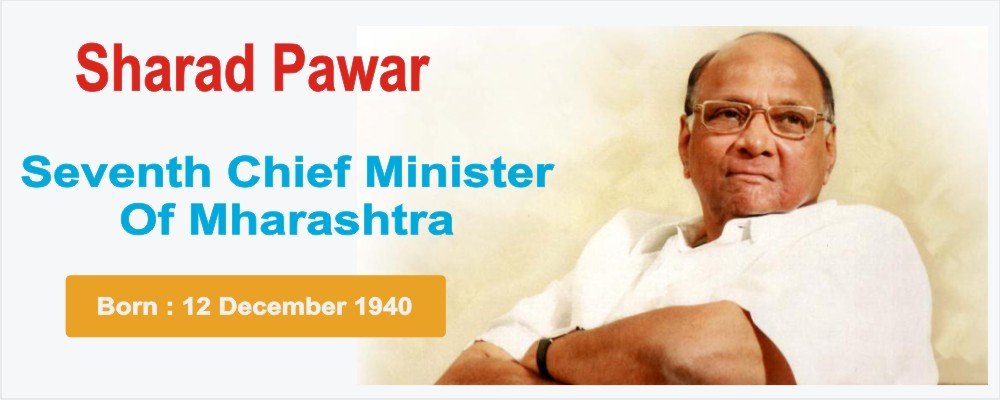
Sharadchandra Govindrao Pawar born 12 December 1940) is an Indian politician known for his long career and national politics. Pawar served three terms as the Chief Minister of Maharashtra, held cabinet positions in the Union Council of Ministers, including the Minister of Defence under P. V. Narasimha Rao and Minister of Agriculture under Manmohan Singh, and is the founder and long-time leader of the Nationalist Congress Party (NCP) which he helped establish in 1999, following a split from the Indian National Congress. He is widely regarded for his influence in Maharashtra’s politics and rural society, having been compared to Chanakya due to his long-standing role in coalition politics and grassroots networks in Indian Politics.
Born in Baramati, Maharashtra, Pawar is the patriarch of the Pawar political family, including his daughter Supriya Sule, nephew Ajit Pawar, and grandnephew Rohit Rajendra Pawar.
Pawar served as the President of the Board of Control for Cricket in India (BCCI) from 2005 to 2008 and of the International Cricket Council (ICC) from 2010 to 2012. He also headed the Mumbai Cricket Association from October 2013 to January 2017.
He received the Padma Vibhushan, India’s second-highest civilian honor, in 2017.
Personal life and family
Sharad Pawar is one of eleven children born to Govindrao Pawar and Shardabai Pawar. Govindrao’s ancestors were relocated to Baramati from the nearby Satara region. Govindrao had a long career with the Sahakari Kharedi Vikri Sangh, a Baramati Farmers’ Cooperative. He also managed Shahu Boarding, a student hostel, during the 1940s. In the 1950s, he was involved in the establishment of cooperative sugar mills in the area.
Govindrao Pawar was elected to the district local board three times between 1937 and 1952. He also managed his family’s farm located in Katewadi, ten kilometres from Baramati. Sharad Pawar completed his education up to the 10th standard (SSC) under the Maharashtra State Board of Secondary and Higher Secondary Education at Maharashtra Education Society’s High School in Baramati.
Pawar is married to Pratibha (née Shinde), daughter of the test cricketer Sadashiv Shinde. Their daughter Supriya Sule represents the Baramati constituency in the 17th Lok Sabha.
He is a senior member of the Pawar political family of Maharashtra. The family has two Members of Parliament and two Members of the state Legislative Assembly. Among them, Ajit Pawar was the deputy chief minister of Maharashtra.[16][6][17][18]
Pratap Pawar, Pawar’s younger brother, runs the Marathi daily newspaper Sakal. One of Pawar’s nephews, Ajit Pawar, is also a politician and currently serves as one of the two Deputy Chief Ministers of Maharashtra. His grandnephew Rohit Rajendra Pawar represents the Karjat constituency in the Maharashtra Vidhan Sabha.
Political career
Early career
Pawar’s first political activity was organizing a protest march for Goan Independence in Pravaranagar in 1956. Although his older lawyer brother belonged to the Peasants and Workers Party, Pawar preferred the Congress party and joined the Youth Congress in 1958. He later became the president of the Poona district (now Pune district) Youth Congress in 1962, and by 1964 had become one of two secretaries of the Maharashtra Youth Congress.
1967–1978
In 1967, when he was 27, Pawar was nominated as the candidate for the Baramati of the Maharashtra Legislative Assembly over more established members by the undivided Congress Party. He won the election and represented the constituency from 1967 to 1990. In 1969, when the Congress Party split after the 1969 Indian presidential election, he opted for the Congress(R) faction of Prime Minister Indira Gandhi, along with his mentor Yashwantrao Chavan.
As the MLA of Baramati in the early 1970s, he was instrumental in building percolation tanks during a severe drought in Maharashtra. He was also heavily involved in the politics of the local cooperative sugar mills and other member-run cooperative societies.
In the early 1970s, the Chief Minister at the time, Vasantrao Naik, had been in power for almost a decade, and there was jockeying for succession among different factions of the state Congress party. Prominent leaders such as Shankarrao Chavan, who was a key figure in Maharashtra politics, and other emerging leaders were among those positioning themselves for influence and potential leadership roles. At that time, looking to the future leadership of the party, Yashwantrao Chavan persuaded Naik to bring Pawar into his cabinet as state home affairs minister in March 1972.[23]
1978-1987
In the 1977 Lok Sabha elections, The Congress Party, under Indira Gandhi, lost power to the Janata Alliance. Taking responsibility for the loss of a large number of seats in Maharashtra, Chief Minister Shankarrao Chavan resigned shortly afterwards and was replaced by Vasantdada Patil. Later that year, the Congress Party split again, with Pawar’s mentor Yashwantrao Chavan joining one faction, Congress (U), and Indira Gandhi leading her faction, Congress (I). Pawar joined the Congress (U) faction. In the state assembly elections held early in 1978, the two Congress parties ran separately but then allied to keep power for Vasantdada Patil. This was in response to the rise and success of the Janata Party, which emerged as the minority government after the election. Pawar served as Minister of Industry and Labour under the Patil government.[24]
In July 1978, Pawar broke away from the Congress (U) party to form a coalition government with the Janata Party. In the process, at the age of 38, he became the youngest Chief Minister of Maharashtra.[25][26][27] This Progressive Democratic Front (PDF) government was dismissed in February 1980, following Indira Gandhi‘s return to power.
In the 1980 elections, Congress (I) won the majority in the state assembly, and A.R. Antulay took over as chief minister. Pawar took over the Presidency of his own Congress (S) party in 1983. For the first time, he won the Lok Sabha election from the Baramati parliamentary constituency in 1984. He also won the state assembly election of March 1985 from Baramati and preferred to return to state politics, resigning his Lok Sabha seat. Congress (S) won 54 seats out of 288 in the state assembly, and Pawar became the leader of the opposition of the Progressive Democratic Front coalition, which included the BJP, PWP, and the Janata party.[28]
1987–1990
Pawar’s return to Congress (I) in 1987 has been cited as a reason for the rise of the Shiv Sena during that period.[28] At the time, Pawar stated that his decision was driven by “the need to save the Congress Culture in Maharashtra“. In June 1988, Prime Minister of India and Congress President Rajiv Gandhi inducted then Maharashtra Chief Minister Shankarrao Chavan into his Union Cabinet as Finance Minister; Pawar was chosen to replace Chavan as the Chief minister. Pawar had the task of checking the rise of the Shiv Sena in state politics, which was a potential challenge to the dominance of the Congress in the state.[29] In the 1989 Lok Sabha elections, Congress won 28 seats out of 48 in Maharashtra. In the state assembly elections of February 1990, the alliance between the Shiv Sena and the Bharatiya Janata Party posed a stiff challenge to Congress. Congress fell short of an absolute majority in the state assembly, winning 141 seats out of 288. Pawar was sworn in as chief minister again on 4 March 1990, with the support of 12 independent members of the legislative assembly (MLAs).[citation needed]
Early 1990s
During the 1991 election campaign, former Prime Minister Rajiv Gandhi was assassinated. The party elected P.V. Narasimha Rao as the party president. It was expected that the party president would become the prime minister in the event of a Congress victory.[30][31] However, Pawar at that time had talked about the distinction between the party president and prime minister.[citation needed] Since the Congress contingent from Maharashtra was the largest, Pawar felt he had a legitimate claim for the post of prime minister. However, Pawar eventually decided not to enter the contest. The Congress Parliamentary Party (party MPs) unanimously elected P.V. Narasimha Rao as their leader, and he was sworn in as prime minister on 21 June 1991.[32] Rao named Pawar as defence minister. On 26 June 1991, Pawar took over that portfolio and held it until March 1993. After Pawar’s successor in Maharashtra, Sudhakarrao Naik, stepped down following the Bombay riots, Rao asked Pawar to serve again as chief minister of the state. Pawar was sworn in as chief minister for his fourth term on 6 March 1993. Almost immediately, Mumbai experienced a series of bomb blasts, on 12 March 1993. Pawar’s response to the blasts attracted controversy. More than a decade later, Pawar admitted that he had “deliberately misled” people following the bombings by saying that there were “13 and not 12” explosions, and had added the name of a Muslim-dominated locality to show that people from both communities had been affected.[33] He attempted to justify this deception by claiming that it was a move to prevent communal riots, by falsely portraying that both Hindu and Muslim communities in the city had been affected adversely. He also admitted to lying about evidence recovered and misleading people into believing that it pointed to the Tamil Tigers as possible suspects.[33]
Mid-to-late 1990s
In 1993, the Deputy Commissioner of the Brihanmumbai Municipal Corporation, G. R. Khairnar, made a series of accusations against Pawar for being involved in corruption and protecting criminals.[34][35] Though Khairnar could not produce any evidence in support of his claims, it inevitably affected Pawar’s popularity. Notable social worker Anna Hazare started a fast-unto-death to demand the expulsion of 12 officers of the Maharashtra state forest department who had been accused of corruption. The opposition parties accused Pawar’s government of trying to shield the corrupt officers.[36]
The 1994 Gowari stampede occurred at Nagpur, during the winter session of the state assembly, and killed 114 people. Nagpur Police were trying to disperse almost 50,000 Gowari and Vanjari protesters using baton charges but the police created panic and triggered a stampede amongst protesters.[37] Allegations were made that the mishap occurred because welfare minister Madhukarrao Pichad did not meet with the delegation of the Vanjari people in time. Though Pichad, accepting responsibility for the mishap, stepped down, this incident was another setback to Pawar’s government.[citation needed]
After 16 years of protest by the Namantar Andolan (Name-change Movement), the state government finally renamed Marathwada University as Dr. Babasaheb Ambedkar Marathwada University on 14 January 1994, the compromise new name being an expansion of the old name (Namvistar) rather than a complete change of name (Namanatar). As chief minister, Pawar announced a few developments in university departments.[38][clarification needed]
New elections to the Vidhan Sabha were held in 1995. The Shiv Sena–BJP coalition was leading Congress in the polls, and there was widespread rebellion in the Congress party.[citation needed] Shiv Sena-BJP won 138 seats while Congress retained only 80 seats in the state assembly. Pawar had to step down, and Shiv Sena leader Manohar Joshi took over as chief minister on 14 March 1995. Until the Lok Sabha elections of 1996, Pawar served as the Leader of the Opposition in the state assembly. In the 1996 General elections, Pawar won the Baramati seat in the Lok Sabha and left the state assembly.[citation needed]
In June 1997, Pawar unsuccessfully challenged Sitaram Kesri for the post of President of the Indian National Congress. In the mid-term parliamentary elections of 1998, Pawar not only won his constituency, Baramati but also led Congress to a win by a large majority[clarification needed] of Maharashtra Lok Sabha constituencies. Congress was aligned with the Republican Party of India (Athvale) and Samajwadi Party for the Lok Sabha elections in Maharashtra. The Congress party won 33 Lok Sabha seats outright, and the allied Republican Party of India won 4 more, for a total of 37 out of 48 in the state. Pawar served as Leader of the Opposition in the 12th Lok Sabha.[citation needed]
Formation of Nationalist Congress Party
In 1999, after the 12th Lok Sabha was dissolved and elections to the 13th Lok Sabha were called, Pawar, P. A. Sangma, and Tariq Anwar demanded that the party propose someone native-born as the prime ministerial candidate, instead of the Italian-born Sonia Gandhi, who had entered party politics and replaced Kesri as Congress president. This led to the trio’s expulsion from the party by the Congress Working Committee (CWC).[39] In response, Pawar and Sangma founded the Nationalist Congress Party in June 1999. Despite the falling out, the new party aligned with the Congress party to form a coalition government in Maharashtra after the 1999 state assembly elections to prevent the Shiv Sena-BJP combine from returning to power.[40] Pawar, however, did not return to state politics and Vilasrao Deshmukh of Congress was chosen as chief minister, with Chagan Bhujbal representing the NCP as deputy chief minister.
Minister of agriculture in UPA government

After the 2004 Lok Sabha elections, Pawar joined the United Progressive Alliance (UPA) government headed by Prime Minister Manmohan Singh as the Minister of Agriculture.[41] He retained his portfolio when the UPA coalition government was reelected in 2009. He faced several crises and controversies during his tenure as Agriculture minister. Critics also point out that during his tenure as the minister of agriculture, he spent more time on cricket in his role as the president of BCCI than on his ministerial duties.[13]
Wheat imports
In 2007, the BJP asked for Pawar’s resignation after alleging he was involved in a multi-crore Indian rupee (INR) scam involving wheat imports. In May 2007, a tender floated by the Food Corporation of India (FCI) for the procurement of wheat was cancelled when the lowest bid received was for US$263/ton. The government subsequently allowed private traders to purchase wheat directly from farmers that year, resulting in a paucity of wheat to stock FCI granaries. By July 2007, the shortage at FCI was large enough to require the import of wheat at a much higher price of 320–360 USD/ton. Taking advantage of this, traders who had domestically purchased wheat at 900 INR/ton earlier were now offering the same to FCI at 1,300 INR/ton.[42][43]
Agricultural produce prices
As the Minister of Agriculture, Pawar was consistently accused of colluding in the extreme hike in prices of agricultural produce:
- Wheat import in 2007 – The Bombay High Court issued notices to Union agriculture minister Pawar, questioning the decision to import defective red wheat, and asking for a directive to submit details of procurement of the crop from different states and the exact process of importing it.[44][45]
- Sugar prices in 2009 – Opposition parties, including the BJP and the CPI(M) accused Pawar of engineering a steep rise in the price of sugar to the advantage of hoarders and importers.[46]
- Wheat, Sugar, Rice, and Bean prices in 2009–2010 – The opposition accused Pawar of being responsible for the issue of spiraling prices.[47]
Farmer suicides
Since the 1990s, India has witnessed a high number of farmer suicides- over 10,000 each year, totaling more than 200,000 between 1997 and 2010.[48] In 2006, as the Minister of Agriculture, Pawar was criticized for downplaying the rate of farmer suicide in the country.[49] However, he claimed at that time that his department was taking the necessary steps to reduce the numbers.[50][citation needed] His ministry initiated a series of government inquiries to look into the causes of farmers’ suicides in 2012. In 2013, Pawar admitted that the suicides were a serious issue with many factors being responsible, and he said the government was increasing investment in agriculture and raising minimum prices of crops to increase farmers’ income.[51]
Promotion of endosulfan
Even though the pesticide endosulfan has been banned, India is slow to phase it out.[citation needed] Despite of its known negative health effects, Pawar remarked that endosulfan has not yet proved dangerous. This remark prompted activist Dr. Vandana Shiva to call him a corrupt minister.[52][53][54]
Other issues
In 2012, Pawar gave up the chairmanship of the Empowered Group of Ministers investigating the 2G spectrum case, days after his appointment by the prime minister, fearing that his association with the decision-making process would drag him into the 2G Spectrum controversy.[55] In 2011, he resigned from the committee that was reviewing the draft of the anti-corruption Lokpal bill after his involvement was criticized by the anti-corruption campaigner, Anna Hazare.[56]
Career since 2014
In January 2012, Pawar announced that he would not contest the 2014 Lok Sabha elections, to make way for young leadership.[57] Pawar is at present a member of the Rajya Sabha. He was elected to the body in April 2014 for a six-year term. He lost his ministerial position after the BJP-led NDA defeated the ruling UPA government, in which Pawar was the minister of agriculture, in the 2014 general elections.[58] Pawar’s NCP also lost power in Maharashtra after the 2014 assembly elections. The BJP won a plurality of seats in the new assembly and initially formed a minority government with outside support from the NCP.[59] The BJP’s estranged ally, the Shiv Sena later joined the BJP-led government, and that government then did not need the support of the NCP. In May 2017, Pawar ruled out being a candidate for the June 2017 Indian presidential election.[60]
In the 2019 elections to the Lok Sabha, Pawar’s NCP and the Congress party had a seat-sharing arrangement.[61] Similarly, despite ideological differences, the BJP and Shiv Sena once again contested the elections together under the National Democratic Alliance (NDA) banner.[62] The election resulted in a landslide victory to Narendra Modi‘s BJP. Out of the 48 seats in Maharashtra, the Congress party won only one seat in the state, whereas the NCP won five seats from its stronghold of western Maharashtra.[63]
The 2019 Lok Sabha elections were followed by elections to the Vidhan Sabha in October 2019.[citation needed] Predictions for the state’s ruling BJP–Shiv Sena alliance to win by a large margin led to a steady stream of defections from the NCP to the ruling alliance. Pawar was the star campaigner for the NCP-Congress alliance in the state. His campaigning during the assembly election was credited with helping not only the NCP but also the leaderless Congress party.[64] Against predictions, the actual voting left the ruling alliance with fewer seats than in 2014. Differences between the Shiv Sena and the BJP led to a month of political drama, with Pawar and his family playing a pivotal role. The drama ended with the NCP coming back into power on 28 November 2019, as part of a coalition between Shiv Sena, Congress, and the NCP, led by the Shiv Sena chief, Uddhav Thackeray, as the new chief minister of Maharashtra.[65]
In June 2020, Pawar was re-elected to the Rajya Sabha.[66]
Sharad Pawar, the founder and chief of NCP since 1999, announced his decision to step down from his post and also his unwillingness to contest elections in the future, at the launch of the second edition of his political memoirs ‘Lok Maze Sangati’ (‘People Accompany Me’). Sharad Pawar has had a long period of public life from 1 May 1958 to 1 May 2023.[67]
Sharad Pawar took back his decision to step down as national leader of the National Congress Party, citing “strong sentiments” his resignation had evoked among the party workers as well as leaders across the country. The octogenarian leader clarified that he would focus on assigning new responsibilities through organizational changes and creating new leadership.[68]
2023 Ajit Pawar’s rebellion
In July 2023, Ajit Pawar rebelled against Sharad Pawar, joined the ruling BJP-Shiv Sena government, and took oath as Deputy Chief Minister of Maharashtra. A majority of NCP’s sitting MLAs deserted the party in support of Ajit Pawar. He claimed to the Election Commission that he was the president of the NCP.[attribution needed] Later, in his followers’ first public meeting, he claimed ownership over the party, including both its name and election symbol. This rebellion resulted in a schism in the party, between those who stayed loyal to Sharad Pawar and those who supported Ajit Pawar, similar to the 2022 Shiv Sena political crisis.[69] He also launched the Sharad Pawar Inspire Fellowship (2024–25) aimed at empowering agriculture graduates, underscoring his long-standing focus on rural and farming issues.[70] In late 2024, Pawar, while addressing a meeting a Baramati stated that he may not seek re‑election to the Rajya Sabha when his current term ends in April 2026, signaling a possible gradual withdrawal from active parliamentary politics.[71]
Member of the coordination committee of Indian National Developmental Inclusive Alliance
Pawar has been appointed a member of the Coordination Committee of the Indian National Developmental Inclusive Alliance at its Mumbai convention on 1 September 2023.[72][73] The coordination committee will decide the national agenda, common campaign issues and common program of the country’s main opposition alliance (I.N.D.I.A.). Lorem ipsum dolor sit amet, consectetur adipiscing elit. Ut elit tellus, luctus nec ullamcorper mattis, pulvinar dapibus leo.