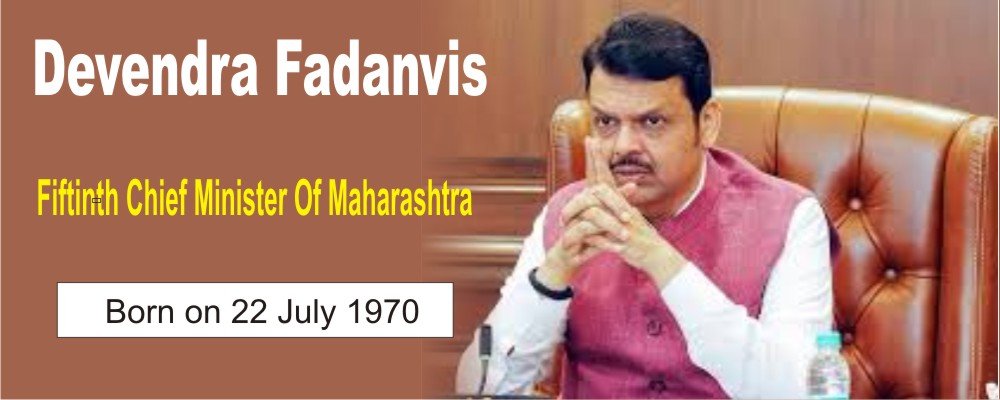
Devendra Gangadharrao Fadnavis (born 22 July 1970) is an Indian politician who is currently serving his third term as the 18th Chief Minister of Maharashtra since 5 December 2024. He previously served as the Deputy Chief Minister of Maharashtra, alongside Ajit Pawar in the Eknath Shinde government. From 2019 to 2022, he also served as the Leader of the Opposition in the Maharashtra Legislative Assembly. He became Chief Minister at the age of 44, making him the second-youngest in Maharashtra’s history after Sharad Pawar.
During the 2019 Maharashtra political crisis, Fadnavis held a second term as Chief Minister for 5 days before resigning on 28 November 2019. He has been a member of the Bharatiya Janata Party (BJP) and the Rashtriya Swayamsevak Sangh (RSS). He has served as the President of BJP’s Maharashtra state unit from 2013 to 2015. He has represented the Nagpur South West constituency in the Maharashtra Legislative Assembly since 2009, having previously served Nagpur West from 1999 to 2009. He was also the Mayor of Nagpur from 1997 to 1999.
Life and education
Fadnavis was born in a Marathi Deshastha Brahmin family in Nagpur to Gangadhar and Sarita Fadnavis. His father was a member of the Maharashtra Legislative Council from Nagpur. His mother belonged to the Kaloti family of Amravati and had previously served as a director of the Vidarbha Housing Credit Society.
Fadnavis did his initial schooling at the Indira Convent School in Nagpur. During the 1975 Emergency, Fadnavis’s father, being a member of the Jan Sangh, was imprisoned for participating in anti-government protests. Fadnavis subsequently refused to continue his schooling at Indira Convent, as he did not want to attend a school named after Indira Gandhi, the Prime Minister he held responsible for imprisoning his father. He was then transferred to the Saraswati Vidyalaya School, Nagpur, where he received most of his schooling. Later, Fadnavis attended Dharampeth Junior College.
Fadnavis completed his Bachelor of Laws undergraduate degree from Dr. Babasaheb Ambedkar College of Law, Nagpur University in 1992. He completed his postgraduate degree in Business Management and a diploma in Project Management from DSE, Berlin, Germany.

Fadnavis practices Hinduism. He married Amruta Fadnavis, an actress, singer and banker, in 2005. Both of them met at a marriage ceremony of a common friend. After two years of marriage, the couple had a daughter, Divija Fadnavis, in 2007.
Early political career (1989–2014)
Many of Fadnavis’s family members have been involved in electoral politics. Both his father, Gangadhar Rao Fadnavis, and aunt, Sobha Fadnavis, were members of the Bharatiya Janata Party and served in the state legislature. Fadnavis joined the RSS-affiliated Akhil Bharatiya Vidyarthi Parishad (ABVP) in 1989.Later in the year 1992, he became a Councillor, representing the Ram Nagar Ward in the Nagpur Municipal Corporation. In 1997, at the age of 27, Fadnavis became the youngest mayor of the Nagpur and the second-youngest mayor in the history of India. He took the decision to double property tax in Nagpur, raising 35 crore rupees for the municipal corporation. He remained as a Mayor until 1999, and later held a position in the newly created Mayor in Council from 1999 to 2001,[26] after the system was introduced by the Maharashtra government in 1998.
Fadnavis was elected to the Maharashtra Legislative Assembly in the 1999 elections after he won in the Nagpur West constituency. In the 2004 elections, he was re-elected to the assembly from the same constituency. Later in the 2009 elections, he contested from the newly created Nagpur South West constituency.
Fadnavis took over as the president of the Maharashtra unit of the BJP in 2013. His appointment to this position has been credited to his closeness with the RSS. According to political commentators, the party appointed him based on advice of the RSS. Fadnavis being one of the youngest BJP state presidents, his appointment was also seen as an attempt by the party to attract youth voters. His appointment was made when tensions between the then deputy Leader of Opposition in Lok Sabha Gopinath Munde and the former BJP national president Nitin Gadkari were high. His appointment to the position was seen as a mutual compromise by Gopinath Munde-led and Nitin Gadkari-led factions within the state unit of the party.
During his term as the party president, he criticised the Congress and NCP government for their alleged irrigation scam. He used the issue heavily in successive election campaigns for the Lok Sabha election and the State legislative assembly election.
First term as chief minister of Maharashtra (2014–2019)
Background and government formation
In the run up to the 2014 legislative elections, the BJP and the Shiv Sena severed their ties, and contested the elections separately. The fracture in the alliance resulted from disputes over the chief ministerial candidate of the alliance and the number of constituencies that each parties will contest. After the elections, the BJP became the single largest party, while the Shiv Sena became the second largest party.
Fadnavis took over as the legislative party leader of the BJP in the state after winning a vote by the newly elected MLAs of the party. Fadnavis was appointed as the Chief Minister of Maharashtra on 31 October 2014. BJP formed a minority government initially with confidence and supply from the Sharad Pawar-led Nationalist Congress Party. The erstwhile alliance partner Shiv Sena chose to stay in opposition, with its legislative party leader Eknath Shinde briefly serving as the leader of the opposition. However, soon after, the Shiv Sena joined the Fadnavis-led government, giving the government a majority. Fadnavis completed his first term for the complete five years, making him only the second person in the state to do so, the other being Vasantrao Naik.
Infrastructure Projects

During his first term as the chief minister of Maharashtra, Fadnavis oversaw critical infrastructure projects such as the conceptualisation of the Mumbai–Nagpur Expressway, the Mumbai and Pune Metro expansions, the Coastal Road project, and the Mumbai Trans Harbour Link (MTHL). He also established a dedicated “War Room” to monitor all the major infrastructure projects in order to address the bottlenecks and ensuring timely completion. In 2019, the government initiated a scheme to set up a water grid project in Marathwada to address the drought situation. The project included a plan for water grid from Israeli partners.
Social policies and issues
The Bombay High Court stayed the reservation decision on the Maratha Reservation Act in 2015. Following this, Fadnavis constituted the Backward Class Commission in 2015, as directed by the High Court to confirm that the Marathas constitute as a backward community.
2019 political crisis
2019 election and BJP – Shiv Sena breakup
In the 2019 legislative assembly election, the Mahayuti alliance, comprising BJP, Shiv Sena, and other regional parties, contested together. During the campaigns, a chief ministerial candidate from the alliance was not projected. Many Shiv Sena politicians even claimed that the next chief minister will be from their party.
After the elections, the Mahayuti secured a majority, with the BJP becoming the single largest party again. During the talks of government formation, disagreements surfaced between BJP and Shiv Sea regarding the chief minister position. Shiv Sena, led by Uddhav Thackeray, demanded that the chief ministership should be shared between the parties in a rotation government arrangement. Politicians from Shiv Sena claimed that decision was made between the top leadership of the two parties where candidates from both the parties will occupy the position of chief minister for 2.5 years each. However, this claim was disputed by Fadnavis, and he said that no such promises have been made and he would become the chief minister for 5 years. After successive meetings, no consensus was reached, and the alliance between the parties broke.On 8 November 2024, Fadnavis resigned as the chief minister.
Following this, the then Maharashtra Governor Bhagat Singh Koshyari invited the major parties, including BJP, Shiv Sena, and NCP, to form government. However, due to no consensus being reached, president’s rule was imposed in the state on the recommendation of the governor.
Second term as Chief Minister (2019)
On 23 November 2019, Fadnavis reached the residence of Governor Koshyar with the NCP leader Ajit Pawar to form their government. Fadnavis was sworn in as the Chief minister, while Pawar was sworn in as the Deputy Chief Minister. However, soon later, NCP chief Sharad Pawar announced that Ajit Pawar’s decision to support the BJP was his own and not endorsed by the party. Shiv Sena, NCP, and INC took up this issue in the Supreme Court of India. On 26 November 2019, The court ordered the new government to prove their majority with a Floor test in the legislative assembly. Due to lack of adequate support, on the very same day, Fadnavis and Ajit Pawar resigned from their posts of Chief Minister and Deputy Chief Minister respectively.
During this short period, Fadnavis chaired a climate resilience meeting with representatives of the World Bank, restarted the Chief Minister’s refund cell, and sanctioned ₹5380 crores in aid for farmers. The government lasted for about 80 hours. His second tenure was the shortest tenure for any chief minister of the state since its inception.
Leader of opposition (2019–2022) and deputy chief minister of Maharashtra (2022−2024)
Leader of Opposition in Maharashtra Legislative Assembly (2019–2022)
After the second Fadnavis government collapsed, BJP became the main opposition party against the newly appointed MVA government led by Uddhav Thackeray. Being elected as the party leader of BJP in the Maharashtra Legislative Assembly, Fadnavis assumed the role of the Leader of the Opposition.
Role in 2022 Maharashtra political crisis
Fadnavis played a key role in the 2022 political crisis that led to the fall of Uddhav-led government and a virtual split in Shiv Sena. After a significant amount of Shiv Sena MLAs rebelled against the party leadership, Fadnavis and Union Home minister Amit Shah met the leader of the rebels Eknath Shinde in Vadodara, Gujarat to reportedly plan a merger coalition to topple the Uddhav led government.[76] On 28 June 2022, Fadnavis met Governor of Maharashtra Bhagat Singh Koshyari and demanded a motion of no confidence against Uddhav Thackeray. Fadnavis himself has claimed that he caused the split within the party. On 29 June, Uddhav Thackeray resigned as the Chief Minister while speaking live on social media ahead of the no-confidence motion.
Deputy chief minister of Maharashtra (2022–2024)
The next day, on 30 June 2022, Fadnavis was sworn in as the ninth Deputy Chief Minister of Maharashtra, with Eknath Shinde as the chief minister. During this time, he held key ministries, including Home Affairs, Law and Judiciary, Water Resources, Command Area Development, Energy, New and Renewable Energy, and Protocol. Initially, before the formation of the government, Fadnavis said in a press conference that he personally will not be a part of the new government, although BJP will join it. According to media reports, Fadnavis was reluctant to become the deputy chief minister. However, BJP national president J. P. Nadda directed Fadnavis to join the government.
Many political commentators have highlighted the position of deputy chief minister to be a downgrade or demotion for Fadnavis. Nevertheless, his role in the government was considered key by political commentators in keeping a check on the Shinde-led Shiv Sena by the top BJP leadership. Fadnavis become the fifth person to become a minister in a state government after serving as the chief minister.